 Skip to content

Introduction
Dogs do not feel guilt the way humans understand it. That head lowered, ears pinned back, tail tucked posture your dog displays when you walk into a room with a destroyed item on the kitchen floor is not remorse-it is a learned response triggered by your body language, tone of voice, and environmental cues. The scientific evidence consistently shows that what most people interpret as a guilty look is actually a set of appeasement behaviors rooted in fear and anxiety, not moral self-reflection.
This article covers what dog parents need to know about canine emotions, the research behind guilty-looking behaviors, and how to respond with effective, science-based dog training methods. Whether you’re a pet parent in Northern Virginia dealing with chewing, poop accidents, or a puppy that raids the trash, understanding what your dog actually feels will transform how you approach unwanted behavior and strengthen the bond between you and your dog.
The direct answer: Dogs display guilty-looking behaviors not because they feel remorse or understand right and wrong, but as conditioned responses to owner cues-facial expressions, voice tone, and posture-that signal displeasure. Dogs respond to human emotions, not their own guilt.
Here’s what you’ll gain from reading this article:
- A clear understanding of which emotions dogs actually experience and why guilt isn’t among them
- The ability to recognize appeasement signals and stop misinterpreting your dog’s behavior
- Science-backed training techniques that address unwanted behavior at its source
- Practical strategies for building a stronger, trust-based relationship with your dog
- Knowledge of when persistent behavioral issues require professional help
Understanding Canine Emotions and Cognitive Abilities
Canine cognition research has advanced significantly over the past two decades, giving us a much clearer picture of what dogs feel and what falls beyond their emotional range. Dogs primarily feel basic emotions like happiness and fear. They experience joy during play, anxiety during storms, anger when resources are threatened, and surprise at unexpected stimuli. These primary emotions are hardwired for survival and social bonding.
But guilt, shame, and remorse belong to a different category entirely-and that distinction matters for every training decision you make.
Primary vs Secondary Emotions in Dogs
Primary emotions-fear, joy, anger, surprise, disgust-are basic affective states with deep evolutionary roots. Dogs experience primary emotions but not complex emotions like guilt. These basic feelings serve immediate survival functions: fear drives avoidance of threats, joy reinforces social bonds, anger protects resources.
Secondary or complex emotions like guilt, shame, and pride require something dogs don’t possess: the ability to reflect on their own actions against an internalized set of moral rules. To feel guilty, an animal must hold a mental representation of what it did wrong, evaluate that act against understood norms, and experience distress over the violation. Dogs do not possess the cognitive ability for guilt or shame in this sense. Research in canine cognition consistently shows that guilt “fits the dog mind poorly,” as researcher Alexandra Horowitz and others have argued.
This doesn’t mean dogs are emotionally simple. Dogs can recognize human emotional cues through body language and tone of voice, making them remarkably attuned social partners. But being responsive to your feelings is fundamentally different from evaluating their own actions as right or wrong.
Canine Cognitive Limitations
A key reason dogs do not feel guilt like humans do is their present-moment cognitive focus. Dogs have a limited ability to mentally connect past actions with current consequences. When you come home hours ago to find a mess and your dog knew something was off, what the dog is actually reading is your current emotional state-not reflecting on the act it committed earlier.
Self-awareness studies reinforce this limitation. Dogs fail the standard mirror self-recognition test, meaning they don’t visually identify themselves. Newer olfactory mirror research shows dogs can distinguish their own scent from that of other dogs, suggesting some self-other distinction-but this sensory awareness is immediate and practical, not the kind of sustained self-reflective consciousness required to feel remorse or feel ashamed.
Timing studies further illustrate the point. Research by Yamamoto, Kikusui, and Ohta (2009) found that delays of just 0.5 seconds between a behavior and its consequence significantly degrade a dog’s ability to associate the two. This means your dog simply cannot connect something it did while you were at work with the upset reaction you display upon returning home.
This cognitive framework is exactly why the “guilty look” phenomenon exists-and why understanding it changes everything about how you should approach training.

The Science Behind the “Guilty Look” Phenomenon
Now that we’ve established what dogs can and cannot cognitively process, we can examine what’s actually happening when your dog gives you that sad, ashamed expression after something wrong has occurred in the house.
What Research Reveals About Dog Guilt
The most influential study on this topic came from Alexandra Horowitz in 2009. In her experiment with 14 dogs, she tested whether dogs showed the guilty look based on whether they had actually eaten a forbidden treat-or based on whether their owner scolded them. The findings were clear: dogs displayed guilty behaviors based on owner reactions, not on whether they had actually committed the misdeed. Dogs that hadn’t touched the treat but were scolded showed more guilty-looking behavior than dogs that had eaten it but weren’t reprimanded.
Follow-up research by Hecht, Miklósi, and Gácsi (2012) expanded on this with a larger sample and combined behavioral experiments with owner questionnaires. In their study, approximately 92.5% of owners believed their dogs feel guilty in certain situations, and 91.8% believed their dog knew when it had done the wrong thing. However, the experimental data told a different story: owners could not identify whether their dog had actually misbehaved at better-than-chance accuracy when relying solely on the dog’s greeting behavior. Dogs’ emotional responses are often misinterpreted as guilt.
The guilty look is often a response to human anger-not an admission of wrongdoing.
Appeasement Behaviors vs True Guilt
The classic guilty look includes behaviors like lowering the head and avoiding eye contact. Dogs can respond to negative signals by exhibiting calming signals like cowering and lip licking. You might also see ears flattened back, tail tucked between legs, or a freeze-and-cower posture. These signs look remarkably like what humans associate with shame or remorse.
But these are appeasement behaviors-social communication signals designed to reduce conflict and de-escalate tension. In canine social groups, a dog may display these same signals toward other dogs to prevent aggression. When directed at humans, these behaviors serve the same function: “I sense you’re angry, and I’m trying to make you less threatening.”
Dogs can exhibit appeasement behaviors when sensing human anger, regardless of whether they’ve done anything wrong. In the Hecht et al. study, these behaviors occurred even when no misdeed had taken place-the trigger was the owner’s disapproving tone, posture, or facial expressions. This is stress and fear, not actual guilt.
How Classical Conditioning Creates the Guilty Look
The guilty look is a learned response to human cues, built through classical conditioning over time. Here’s the process:
Your dog knocks over the trash. You come home, see the mess, and react with an angry voice, stiff posture, and direct eye contact. Your dog displays submissive behaviors. This cycle repeats across multiple incidents. Eventually, the dog learns to associate specific environmental cues-scattered trash on the kitchen floor, your arrival pattern, your initial reaction-with negative consequences.
Dogs learn to associate owner anger with specific situations. The next time those cues appear, the dog preemptively displays appeasement behaviors. The dog isn’t thinking “I did something wrong.” It’s responding to a pattern: “When the room looks like this and my owner walks in, bad things happen.”
Dogs learn to associate scolding with negative outcomes, creating a feedback loop that many dog parents mistake for conscience. The dog may even begin displaying the guilty look before you’ve reacted, because the destroyed item itself has become a conditioned stimulus predicting your displeasure.
Understanding this conditioning process is essential for adopting training approaches that actually work.
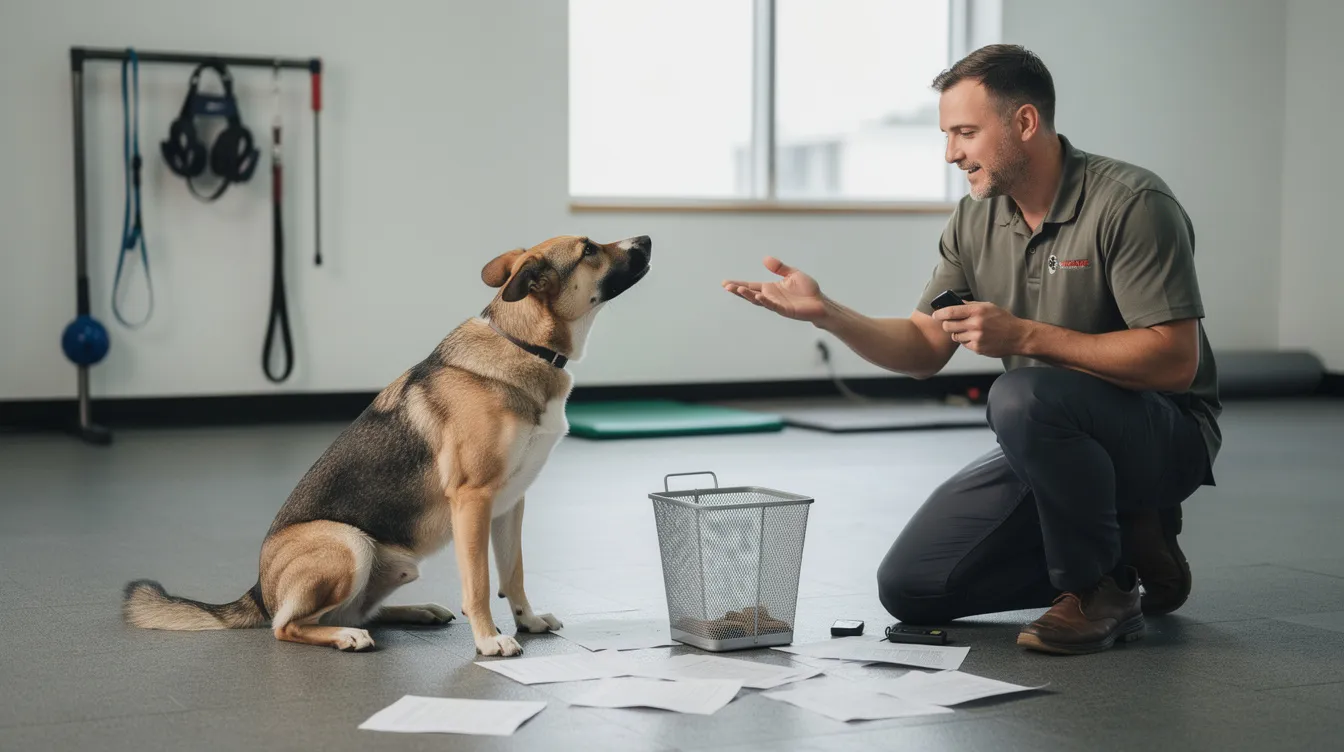
Professional Training Approaches to Unwanted Behaviors
Since dogs don’t feel guilt or understand moral reasoning, trying to “make them feel bad” about misbehavior is not only ineffective-it can actively harm your training progress. The key is working with how dogs actually learn: through immediate feedback, consistent environments, and positive associations.
Prevention and Environmental Management
The most effective strategy for unwanted behavior is preventing it from happening in the first place. If your puppy chews shoes when left alone in the house, the solution isn’t waiting to catch and scold-it’s removing the opportunity.
Specific management strategies include:
- Crate training: Providing a safe, enclosed space when you can’t supervise prevents destructive behavior and gives your dog a calm retreat
- Baby gates and room restrictions: Limiting access to areas with temptations (trash cans, counters, shoe racks) eliminates triggers
- Substitution: Replace forbidden items with appropriate alternatives-if your dog gravitates toward chewing furniture, provide engaging toy options and chews in the same room
- Consistent rules: Ensure every family member enforces the same boundaries so the dog doesn’t receive mixed signals
For example, a dog that raids the trash when home alone doesn’t need punishment-it needs a secured trash can or restricted kitchen access. Addressing behavior at its source through management is far more reliable than attempting to correct it after the fact. For dogs that steal food from counters, specific environmental strategies can resolve the issue entirely.
Timing-Based Correction Techniques
When you do need to interrupt unwanted behavior, timing is everything. The two-second rule applies: any verbal correction or redirect must occur within one to two seconds of the behavior to allow your dog to associate the consequence with the act. After that window closes, the connection is lost.
Research confirms this principle. Yamamoto et al. (2009) demonstrated that delays of just 0.5 seconds begin degrading a dog’s ability to link behavior with outcome. At one to two seconds of delay, obedience rates drop sharply. This is why tone and timing in dog commands matter so much more than volume or intensity.
Proper redirection works like this:
- Catch the behavior as it happens (dog begins chewing a shoe)
- Interrupt with a calm, firm cue (“leave it” or “no”) within one second
- Immediately redirect to an acceptable alternative (offer a chew toy)
- Reward the dog the moment it engages with the correct item
After-the-fact corrections-coming home to find a mess and scolding your dog-fail because your dog cannot associate the punishment with something it did minutes or hours ago. Worse, these delayed corrections increase anxiety and fear without preventing the behavior.
Positive Reinforcement Training Methods
Positive reinforcement is the most effective training method for building lasting behavioral change. The principle is straightforward: reward behaviors you want to see repeated, and they’ll occur more frequently.
Effective positive reinforcement requires:
- Immediate timing: Deliver the treat, praise, or play within one second of the desired behavior
- Consistency: Reward the same behaviors every time during the learning phase
- Gradual challenge increases: Once a behavior is reliable in a quiet room, practice under increasing levels of distraction
This approach builds a trust-based relationship where your dog actively wants to make good choices rather than simply avoiding punishment. Positive reinforcement training with treats creates dogs that are confident, responsive, and genuinely bonded to their owners.
At Off Leash K9 Training, this philosophy drives our distraction-proof methodology. Through structured board-and-train programs and private lessons, we build reliable obedience that holds even under high-arousal conditions-because the training is rooted in how dogs actually learn, not in outdated assumptions about guilt or moral understanding.
Common Training Mistakes and Professional Solutions
Misunderstanding dog emotions doesn’t just lead to frustration-it creates training approaches that actively make behavior worse. Here are the most common mistakes we see and the professional solutions that replace them.
After-the-Fact Punishment Problems
Scolding dogs after the fact increases anxiety and fear without teaching anything useful. When you come home, find poop on the kitchen floor, and drag your dog over to it while raising your voice, your dog doesn’t think “I shouldn’t have done that.” Instead, it learns that your arrival home is sometimes dangerous and unpredictable.
This creates a vicious cycle. The dog becomes more anxious when left alone (potentially worsening destructive behavior or house soiling), and then displays stronger appeasement behaviors when you return-which you interpret as the dog knowing it did the wrong thing, reinforcing your belief that punishment is appropriate.
Professional solution: Abandon after-the-fact punishment entirely. If you didn’t catch the act, the training opportunity has passed. Clean up calmly without interaction, then redirect your energy toward prevention and management strategies. Focus on setting your dog up for success rather than reacting to failure.
Note: On rare occasions, what looks like a behavioral issue may have a medical cause. Sudden house soiling, for instance, could indicate a urinary tract infection rather than disobedience. Always rule out health concerns with your veterinarian before assuming a training problem.
Misinterpreting Appeasement as Guilt
When pet parents see the guilty look-head lowered, ears back, eye contact avoided-many react emotionally. Some raise their voice because they assume the dog “knows better.” Others comfort the dog, inadvertently reinforcing the anxious behavior. Either response feeds the cycle.
Dogs don’t feel guilty about what they’ve done. They feel stressed about what’s happening right now. Your angry tone, stiff posture, and direct stare are the triggers, not their memory of chewing the couch cushion.
Professional solution: Practice a calm, neutral return every time you come home-regardless of what you find. Don’t scold, don’t comfort excessively. Simply exist in the space without emotional charge. Over time, this reduces your dog’s anticipatory stress and breaks the conditioned association between your arrival and negative consequences. Building your dog’s confidence through training further reduces fear-based behaviors.
When to Seek Professional Behavior Help
Some behavioral challenges go beyond what management and basic training can address. Consider professional help if:
- Destructive behavior persists despite consistent environmental management
- Your dog shows signs of separation anxiety (excessive vocalization, self-harm, escape attempts when alone)
- Aggression toward humans or other dogs occurs in any context
- Reactivity or extreme fear responses appear across multiple situations
- You’ve tried multiple approaches without improvement
A professional behavior assessment can identify root causes-whether the issue is anxiety, insufficient socialization, past trauma, or something else entirely. Board-and-train programs like our Dog Boot Camp provide intensive, structured environments where dogs receive consistent reinforcement and behavior modification from experienced trainers, while owners learn the skills to maintain progress at home.
Conclusion and Next Steps
Dogs don’t feel guilt, and that’s actually good news for your training approach. Once you stop trying to make your dog feel remorse and start working with how canine cognition actually functions, everything gets more effective. Your dog isn’t being spiteful or defiant when it destroys something-it’s behaving like a dog in an environment that allowed the behavior to happen. And that guilty look? It’s your dog reading your emotions and trying to keep the peace.
Here are your immediate action steps:
- Stop punishing after the fact. If you didn’t catch it, let it go and focus on prevention
- Manage the environment. Remove temptations, use crates or gates, and set your dog up for success
- Practice immediate feedback. Keep corrections and rewards within the one-to-two-second window
- Reward what you want. Actively reinforce good behavior rather than only reacting to bad behavior
- Stay calm on arrival. Make your homecoming emotionally neutral to reduce your dog’s anticipatory stress
Understanding your dog’s emotional reality isn’t just an academic exercise-it directly improves training outcomes, reduces stress for both of you, and builds a relationship based on trust rather than fear.
If your dog’s behavior challenges persist or you want to build reliable, distraction-proof obedience, Off Leash K9 Training of Sterling offers free consultations to assess your dog’s needs and recommend a personalized training plan. Reach out through our dog obedience training services page to get started.
